Human-elephant conflict is a serious issue in Assam as growing deforestation in this state has reduced the habitat of elephants, making them encroach human habitats, thereby leading to serious conflicts. Many people have lost lives in the process. Elephants also have been injured badly in the retaliation by people. Loss of lives and property has made this issue very crucial, but not many people ventured to find a solution for it. In this context, I can name a person Binod Dulu Bora, popularly known as Dulu among people, for his path-breaking initiative to solve the problem. I nominated him for the IUCN Commission on Education and Communication Regional Award from the South and Southeastern Asia region in my capacity as member of this IUCN Commission. However he was not selected for it.
Dulu’s longstanding commitment to conservation communication and environmental education has advanced the avowed mission and goals of IUCN in this region, especially in middle Assam. He has mobilised the rural people from Assam in constructive efforts to establish healthy relations between human and animals. Herds of wild elephants used to destroy agricultural output as well as human property in the areas worked in by Dulu, till 2018. But the human settlement in the concerned area now witnesses peaceful cohabitation between human and animals. This has been possible as the agrarian population in that area were successfully convinced and trained by Dulu to join his planned course of action.
Dulu lives at Chapanala, which is 29 kilometres from the middle Assam town of Nagaon. He saw from childhood how elephants used to destroy paddy fields and even houses in the villages. The villages that were affected by the foraging of elephants in and around Chapanala were Sukanjuri, Borbari, Jolah, Bamuni, Kholiamari, Pambosti, Bhoraguri, Padumoni, Samsoki, Bordoi, Balijuri, Kothalguri, Nonoi, Mutiapahar, and Rubberbagan. The villages near Salbari reserve forest were also affected. These were Dariguzi, Chekonee, Gohaingaon, Hatbagan, Doloni, Balibat, Nizarapath. Dulu saw the predicament of these villagers. He sought a way out. It was to create feed for the foraging elephants, so that they could be restrained from entering the paddy fields of the villagers.
Dulu persuaded the villagers not to be aggressive towards the elephants and rather create feed for them. The tribal villagers responded to his plea and joined him in cultivating grass and paddy for the elephants, so that the foraging elephants could be restrained from entering the villages and their paddy fields. The course of action planned and executed by Dulu comprises of plantation of grass and paddy in a buffer land, so that the wild elephants could feed on them. Inhabitants of the Ronghang village donated 200 bigha land, which they had been using for their own paddy cultivation. Now, Sali paddy or winter paddy cultivation is carried out in 186 bighas of this land by a team led by Dulu. This team comprises of inhabitants of nearby villages. They also plant Napier grass and Broom grass in the slopes of the nearby hills, as the elephants like to eat such grass varieties. In addition to these, 15000 banana seedlings were planted in the fringe of the Suwang Reserve Forest. All this worked wonder. Very soon it was seen that the elephants remained confined to the grassland and paddy field, which had been cultivated specially for them by the villagers.
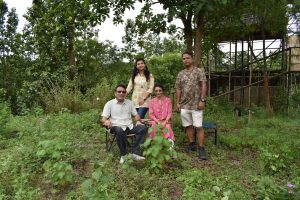
The author and his wife Madhumita with Dulu and Meghna in Hathikhuli forest
This innovative work by Dulu and the villagers drew attention of many people. One such person was the renowned philanthropist, Pradip Bhuyan. In April 2018, an organisation named ‘Hati-bondhu’ was formed with active patronage of Pradip Bhuyan. They mapped the elephant habitat so that the works could be carried out more systematically. Pradip Bhuyan pumped substantial financial resources to undertake innovative works on a bigger scale. Dulu was made field director of the organisation while his wife Meghna Hazarika was made his deputy. Meghna stays constantly with Dulu and even lives in the tree-house near the area of paddy cultivation so that these could be protected from any unwarranted destruction.
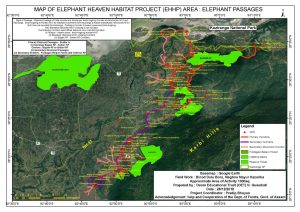
Map of elephant habitat (Courtesy Binod Dulu Bora)
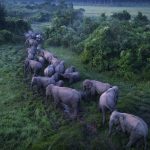
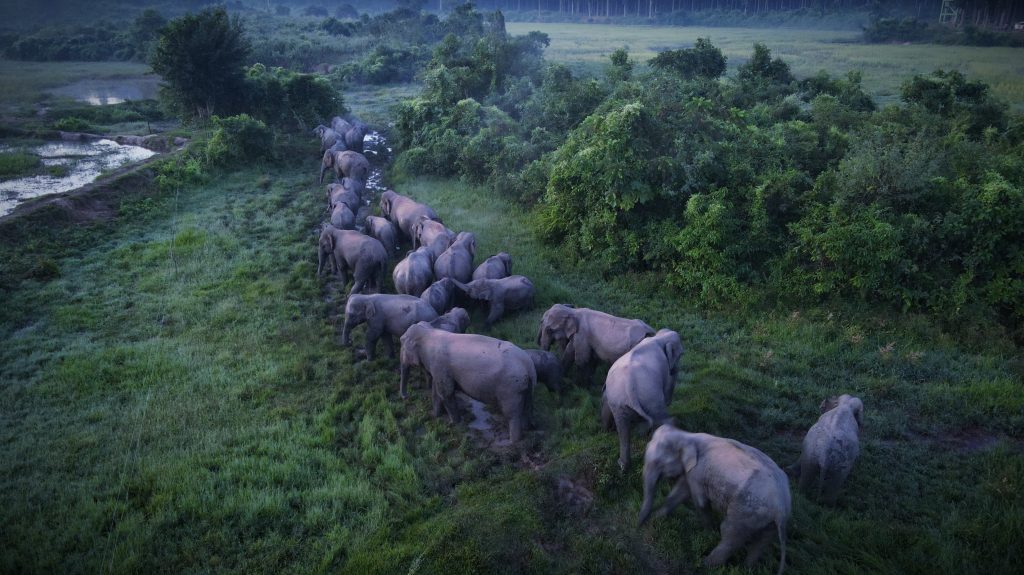
Human-wildlife conflict has been successfully prevented by ‘Hati-bondhu’, under leadership of Dulu. His ‘Hati-bondhu’ organization has planted Napier grass, Broom grass, Tora plant, Elephant apple, Jackfruit, Kumbhir, Kako bamboo etc in 400 bighas land in Ronghang Hatikhuli village by involving local people of nearby villages. For last 6 years since 2018, Dulu and his group has been planting paddy in 200 bighas land in Ronghang Hatikhuli in order to feed wild elephants. It has now become a permanent habitat of 35 wild elephants and other wild animals. Elephants have stopped attacking and killing people after this project was started. The wild animals do not enter human settlements any more in search of food like before. Their behaviour also has changed drastically. They are no more aggressive towards the villagers. They do not enter the paddy cultivation of the villagers and eat only the paddy, which are cultivated exclusively for them. They enter the paddy fields of the villagers only after harvesting is completed, in order to eat the rice straws. Even when they occasionally enter a village, they do not destroy anything like before.
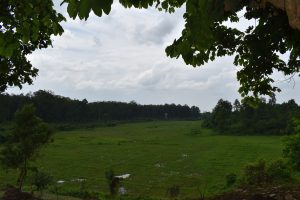
The area where paddy cultivation is done for elephants
On July 6, 2024, I visited the Ronghang Hatikhuli area, accompanied by Dulu and Meghna. We witnessed how the tribal men and women were planting shoots of Napier grass on the slope of the hills. We passed through Napier cultivation, which had been half eaten by the elephants. It is interesting that this grass continues growing even after elephants have eaten it. Thus, one Napier plant can keep on feeding the elephant for several months. It is a great sustainable experiment.
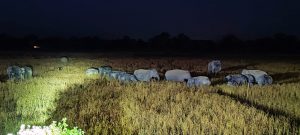
Elephants eating paddy cultivated for them
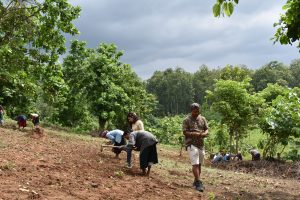
Plantation of Napier shoots, with Dulu in foreground
About 250 elephants come to Ronghang Hatikhuli area from Bagser area, another 80 come from Hojai, Doboka etc to feed on the grass and paddy cultivated for them. Counting the local 35 elephants, which stay in Ronghang Hatikhuli area round the area, 365 elephants are taken care of by ‘Hati-bondhu’. This is a unique experiment, perhaps previously unheard of anywhere in the world.
Rescue of baby elephants, bear cubs, deer, leopards, leopard cat, serow, civets, slow loris, Chinese pangolin etc have also been carried out by Dulu. There have also been rescues of snakes of different species including the rescue of 28 king cobras, which were put back fairly in deep forest. In total, 2700 wild animals have been rescued. Animals feel so free that two elephant cubs have been born in that area.
Additionally, Dulu’s team has worked in the Thuramukh, Rangajan, Murphuloni, Chariyakhat, Bebejia, Lipson, Abhaypur, Tengani, Morongi, Letekujan, Ponka, Kathkotiya, Chandanpur, Mainapara, Juriyadalang, Pholongoni, Bijuli, Bapchong, and Borgaon etc villages of nearby Golaghat district also. The range of their activities now extend over a stretch of 70 kilometres. Dulu, alongwith his wife Meghna has encouraged these villagers to get involved in a project for creation of buffer zone, where wild animals can graze. Even their two and half years old son Ganeshish accompany them in their journeys; he lives with them in the tree-house too.
Dulu has created a sustainable life style so that villagers can live without being subject of aggression by wild animals. As a grassroots conservationist, he has been instrumental in changing mindsets and minimizing violent retaliation against elephant intrusions. He constantly engages with the community, reaching out to women, youth, religious and educational institutions and these efforts have manifested in the area emerging as the hotspot of wildlife rescues. Some of the villagers have been gainfully employed in occupation like weaving. ‘Hati-bondhu’ has set up a weaving centre where garments are woven.
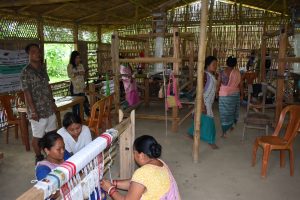
The weaving centre buzzing with activity
Dulu has involved about 600 persons in plantation work for wild animals. Awareness has been done among 5,000 persons. 35 erstwhile hunters gave up hunting and became associated with him. Earlier 40,000 bigha of land in Nagaon district and 70,000 bigha in Golaghat district were affected by wild animals coming in search of food. Villagers and their paddy fields have been protected from attacks by wild elephants as elephants now feed on grassland and paddies specially cultivated in buffer zone.
It is not only creation of fodder for the animals, but also saving them from electrocution, that has been achieved by Dulu’s people. The sagging power lines led to the death of 34 elephants. These sagged power lines, going through the dense forests were lifted by bamboo poles, thereby saving the animals from regular deaths.
But all these was not a cake walk. People did not take him into confidence in the initial years. In 2013, he had even been attacked by some villagers at Mejigaon when he rescued a calf of elephant. But he stood his ground and visited such villages regularly in order to convince them. Over time the villagers gave up the approach of confrontation and embraced peaceful cohabitation with the wildlife. He organised all religion prayers to save wildlife. Villagers even started organising commemoration function for the dead wild animals.
Dulu has impressed the society with his ardent works. His activities have encouraged people to protect wildlife. Many schools, colleges and universities have invited him to deliver lecture on wildlife protection. Young generation of about 200 schools and colleges have also been made aware of the importance of conservation of nature. Nature organisations have heaped accolades on him. Balipara Foundation, Sanctuary Asia, Wildlife Service, Earth Day Network Star, Sanctuary Tiger Defender etc have conferred honour on him. London based Elephant Family appointed him as a consultant for promotion of human elephant coexistence.
With the formation of ‘Hati-bondhu’, government wings like the forest department also came forward to assist Dulu’s team. The divisional forest office at Nagaon has been of good assistance. The staff at Chapanala forest range office have extended full co-operation to them. The success story of ‘Hati-bondhu’ made the forest minister of Assam to laud their effort during a session of the state legislative assembly. A movie titled ‘Hati-bondhu’ also was made about all these in 2022. This movie has been screened in Mumbai, Kolkata, London, Melbourne etc. It got a national award too in India.
It was quite befitting that Prime Minister of India alluded to the successful experiment by ‘Hati-bondhu’ to solve the human-elephant conflict in his popular radio address Mann-ki-Baat on 19th January, 2024. Government of Assam also conferred the ‘Assam Gaurav’ award on this organisation two months later.